
Lincoln County Projected Versus Actual Release
Oklahoma uses the term Projected Release Date, often shortened to PRD. The Oklahoma Pardon and Parole Board defines it as the date ODOC calculates when an offender is estimated to be released. Credits, programs, misconduct, later sentence work, and other events can move it forward or back. The Board does not calculate PRD. It may display the ODOC estimate on an applicable docket, but the parole hearing date and initial parole eligibility date are separate dates.
Actual release is the completed custody event. For Lincoln County Jail, the strongest proof is the sheriff's release entry showing the actual date, time, disposition, authority, or receiving agency. For ODOC, use the final discharge or release document. A projected date does not prove a person left, and a county roster disappearance does not choose between community release and transfer.
A pretrial Lincoln County detainee has no sentence-based PRD. Bond may be posted, a judge may enter an order, a case may end, or another hold may block exit. Even when a court authorizes release, jail staff must receive and process the authority and check for other custody. Use the court docket to understand the legal event and the sheriff record to verify the physical exit.
Find a Lincoln County Projected Release
Start with custody type. The ODOC Offender Lookup is appropriate for a person sentenced to Oklahoma state custody or supervision. It is not the Lincoln County Jail system. Search by ODOC number where known, or use the name and expanded criteria. Compare date of birth, appearance, conviction county, case data, sentence, and status before accepting a match.
The public portal may offer status and date information, and Pardon and Parole Board dockets can show a PRD column. Yet ODOC's current Offender Info FAQ says the exact inmate release date is confidential to a general public requester unless a legitimate qualifying need exists. ODOC gives the inmate days remaining at month end, allowing the inmate to calculate or ask a records officer or case manager and then share the information. Public users should not be promised an exact date in every lookup.
- Decide whether the person is pretrial, serving a county jail sentence, or serving an ODOC sentence.
- For ODOC custody, search by ODOC number or a carefully matched name and read the displayed status and date labels exactly.
- Search the Pardon and Parole Board docket archive for an applicable PRD, using the ODOC number and matching case details.
- For a Lincoln County Jail sentence, obtain the judgment, verify jail credit and the sentence start, then ask the sheriff for the actual release entry.
- When formal state proof is needed, request an existing discharge or sentence-administration record from ODOC through the lawful records route.
For a broader named-person search across Lincoln County custody systems, use the Lincoln County released inmate lookup. It distinguishes county release, state transfer, federal custody, and community supervision.
Note: Record the labels and check date because a portal result may change after sentence auditing or a custody update.
Lincoln County ODOC Date Limits
ODOC reported that its offender portal moved to a new data source and was working through unanticipated issues on the research date. That local search constraint makes corroboration important when a Lincoln County record is missing, inconsistent, or unexpectedly sparse. Use the conviction case, Board docket, discharge contact, and supervision office as distinct checks. A failed search should never be turned into a release claim.
The ODOC Offender Info page explains both confidentiality and the tentative nature of release dates. Its public guidance is illustrated below.
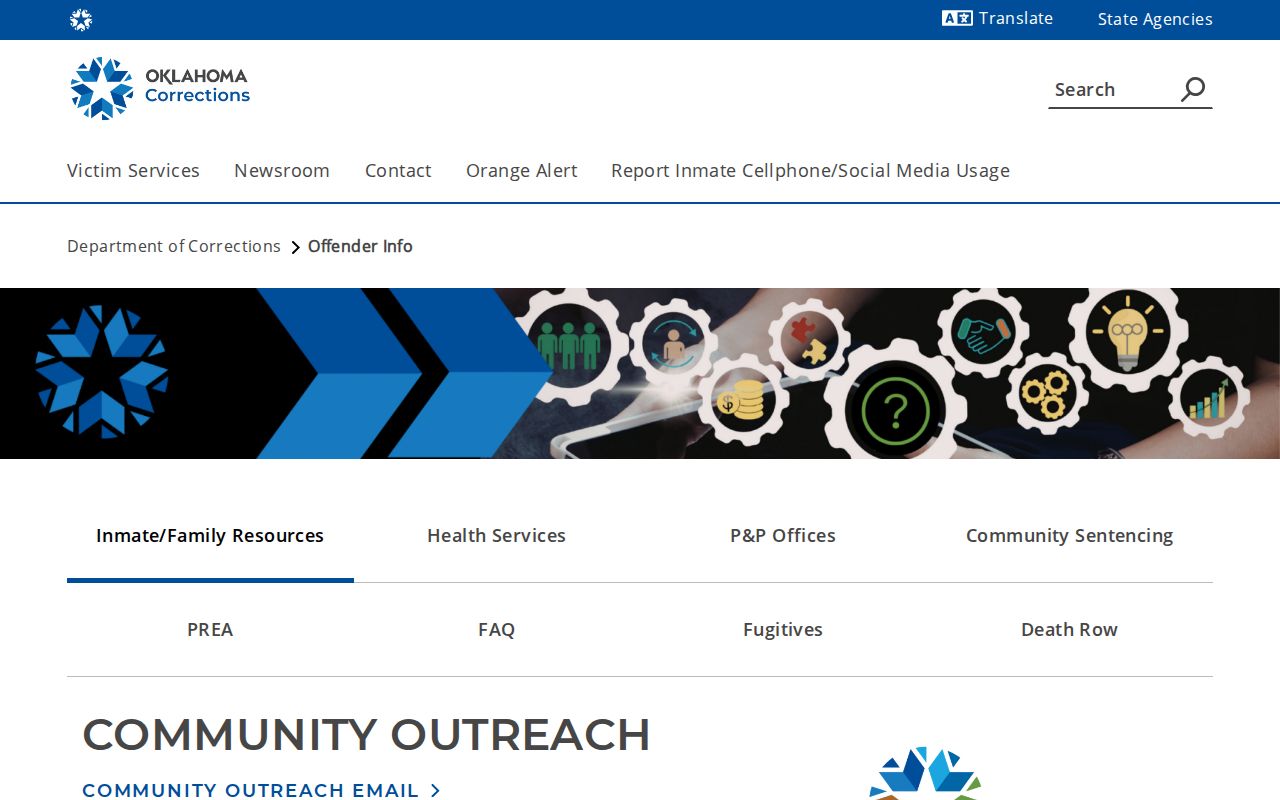
The agency screen supports a careful answer: an exact date may not be public, and any tentative date can change.
For completed state custody, ODOC Legal Services lists osordischarges@doc.ok.gov for discharge questions and an Authorization for Release of Incarceration or Supervision Records. Closed-record questions go to 405-425-2691. Some material requires the subject's authorization, so an open-record demand does not unlock every sentence detail.
Lincoln County Release Date Calculation
An ODOC calculation begins with the judgment and sentence, the lawful commencement or reception framework, credited jail time, and whether terms run concurrently or consecutively. ODOC converts the confinement term into days remaining. Each month, service time and authorized earned credits reduce that balance. Sentence auditing, corrected jail credit, an amended judgment, rebilling to another sentence, restored credit, or a new detainer can alter the account.
The ODOC Service of Sentences and Credit overview describes this days-remaining approach. It is an agency calculation, not a simple subtraction a public user can reproduce from the sentence length. Case-specific rules, dates, offense restrictions, and credit history matter. A maximum monthly rate should never be multiplied over the whole term as if it were guaranteed.
| Factor | How it affects the projected date |
|---|---|
| Jail credit correction | A court or ODOC audit may add or remove recognized time already served. |
| Concurrent or consecutive terms | Sentence structure changes which term controls the remaining balance. |
| Earned-credit class | Lawful monthly credit varies by class, offense group, assignment, and performance. |
| Misconduct or nonperformance | Credits may be withheld or lost, and restoration is discretionary under ODOC rules. |
| Amended court order | Sentence modification, appeal, or post-conviction relief can require recalculation. |
| Detainer or another sentence | The person may remain in custody or be transferred even when one term ends. |
| Parole action | A grant, denial, pass, or required later action can affect the release path without replacing PRD. |
Oklahoma Credits and Lincoln Releases
Under 57 O.S. §138, one earned credit equals one day of incarceration. The law operative on the research date placed people in class levels. Class 1 earned no monthly days. Class 2 earned 22. Class 3 earned 33 days for the felony group listed in subsection E and 45 for others. Class 4 earned 44 days for that listed group and 60 for others.
Progress is conditional. Class 2 entails an assignment in work, education, or a program with good evaluations. Class 3 calls for at least three months and excellent evaluations. Class 4 calls for at least eight months and outstanding evaluations. Section 138 permits credit loss for misconduct, discipline, or nonperformance and allows restoration through ODOC rules. Restoration is discretionary, not an entitlement. Achievement credit also depends on approved program completion.
Date-sensitive note: Oklahoma SB 1213 was approved in 2026 with earned-credit changes scheduled for November 1, 2026. Recheck §138 and ODOC policy after that date.
Achievement credits require their own care. They may depend on completion of an ODOC-authorized program, while ordinary monthly credit depends on classification and performance. A person can move among class levels, lose credit after misconduct, or seek restoration under agency rules. Restored credit is not automatic. These events affect the days-remaining ledger over time, which is why a sentence length and a single monthly credit rate cannot produce a sound public forecast. The calculation also can be rebilled when one term ends and another consecutive sentence takes control.
These are ODOC rules. A judge's Lincoln County Jail-only sentence does not receive a public ODOC PRD merely because it includes days in custody. Pardon and Parole Board Rule 515:25-3-1 excludes time ordered in a non-ODOC facility, such as a county jail, from receiving an ODOC parole-consideration date. Local calculations must be verified with the judgment, Court Clerk, jail credit, and sheriff release entry.
Lincoln County Eighty-Five Percent Rule
21 O.S. §13.1 requires a person convicted of an enumerated serious offense to serve at least 85 percent of the imposed sentence before parole consideration. Credits cannot reduce imprisonment below that floor. The law applies to its listed offenses, not every felony and not every offense casually called violent. The current statute and the actual judgment must be checked.
The 85-percent point is not necessarily PRD and is not a promised release date. It can be a minimum-service or parole-eligibility boundary. The Board can deny or pass a matter, a required Governor action can remain, credits may have been lost, and consecutive terms or holds may control. Another sentence may have a different restriction even if §13.1 does not apply. Use the judgment, ODOC calculation, and current law together.
Weekend Lincoln County Projected Releases
ODOC's Sentence Administration policy OP-060211, effective April 7, 2026, supplies a concrete reason that a mathematical date and operational exit can differ. When an ODOC discharge falls on Saturday or Sunday, policy ordinarily performs discharge on the preceding Friday. For a holiday, it ordinarily uses the last working day before it. If ODOC is rebilling the person to another sentence, the true date is retained.
This rule belongs to state sentence administration. No researched Lincoln County source states that the Lincoln County Jail uses the same early-Friday practice for every local sentence. County jail releases depend on the judgment, bond or court authority, processing, and holds. Ask the sheriff about a specific permitted release detail rather than importing the ODOC rule into county practice.
Note: A Friday ODOC discharge under policy does not show that an unrelated county, federal, tribal, or immigration hold has cleared.
Confirm Lincoln County Actual Release
A pending estimate should be monitored through the correct custodian. For an ODOC prisoner, compare the public status, applicable Board docket, and direct state record. Oklahoma VINE can provide custody-change alerts, but a notification can lag and a transfer alert does not mean freedom. Registration details are covered on the Lincoln County VINELink inmate search.
For Lincoln County Jail, ask Sheriff Records Division for the existing booking and release sheet, including actual date and time, recorded disposition or authority, and destination or receiving agency. Requests may be made in person at 811 Manvel Avenue, Suite 14, Chandler, during the published weekday records window, or by email at KDervin@lincolncountyok.gov. The Court Clerk supplies the judgment or order; the sheriff supplies the physical custody record.
Final confirmation follows the event. A discharge certificate, release form, or sheriff release entry is stronger than a forecast. Record the source, record date, and check time for later comparison when dates differ across systems. Read any transfer notation literally because a transfer closes one custodian's record while custody continues elsewhere.
Public Record Search
Sponsored Results